What Is Line Marking? A Complete Guide for Property Owners
What is line marking, exactly?
Line marking is the process of applying durable lines, symbols, and patterns to asphalt, concrete, or indoor floor surfaces. The markings are used to guide movement, designate spaces, communicate safety rules, and meet compliance requirements set by Australian Standards and state legislation.
You encounter line marking every day without thinking about it. The white bays that tell you where to park. The yellow diagonal lines that keep a fire hydrant clear. The pedestrian crossing outside a school. The forklift corridor running through a warehouse. The sprint lanes on an athletics track. All of it is line marking.
In a commercial context, line marking is one of the most cost-effective ways a property owner can improve safety, organisation, and compliance across a site. When the lines are clear, people and vehicles know exactly where they should and should not be. When they fade, confusion, near-misses, and compliance failures follow.
Where is line marking used?
Line marking applies to almost every environment where people move around on foot or in vehicles. Here are the six most common contexts:
Car park line marking
Bay boundaries, aisle directions, accessible bays, pedestrian paths, entry and exit points. Must comply with AS/NZS 2890.1 for dimensions and layout.
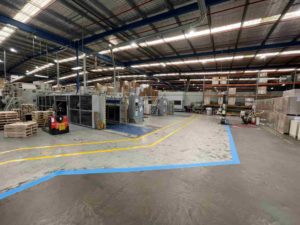
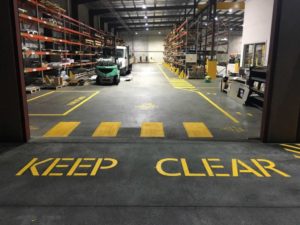
Factory and warehouse marking
Forklift corridors, pedestrian walkways, hazard zones, loading dock areas, storage boundaries, and emergency exits. WHS legislation mandates these in most workplaces.
School line marking
Drop-off zones, sports court lines, playground games, pedestrian crossings, and parking areas. Serves both safety and educational play functions.
Playground line marking
Colourful game patterns, hopscotch grids, four-square courts, running tracks, and activity zones that engage children while keeping play spaces organised.
Sports court line marking
Basketball, netball, tennis, futsal, and multi-sport court lines. Must match the relevant sport’s official court dimensions and colour specifications.
Public area line marking
Council car parks, pedestrian crossings, shared zones, loading areas, and any communal space where clear ground markings improve safety and order.
What materials are used for line marking?
The material is one of the most important decisions in any line marking job. It affects how long the markings last, how quickly the area can be reopened, what surfaces it bonds to, and what it costs to maintain. There are three main options:
| Material | How It’s Applied | Best For | Typical Lifespan |
|---|---|---|---|
| Waterborne acrylic | Sprayed via line marking machine | Open-air car parks, schools, general outdoor surfaces | 2 to 3 years |
| Two-pack epoxy | Mixed on-site, sprayed or rolled | Covered car parks, warehouses, high-traffic or chemical-exposed floors | 5 to 8 years |
| Thermoplastic | Heat-applied, melted onto surface | Road-facing areas, driveways, external high-wear surfaces | 6 to 8 years |
Waterborne acrylic is the most widely used material for commercial property line marking. It meets Australian Standard AS 4049, performs well under UV exposure, and dries in 20 to 30 minutes — fast enough to stage the work in sections without closing a car park entirely. Two-pack epoxy costs more upfront but significantly extends the interval between re-marks on high-traffic covered surfaces. Thermoplastic is the standard for anything road-facing, where durability and retroreflectivity under headlights are critical.
What surfaces can be line marked?
Line marking can be applied to most hard surfaces provided they are prepared correctly before application. The most common surfaces are:
- Asphalt — the standard surface for outdoor car parks and roads. Porous and flexible. Waterborne acrylic and thermoplastic bond well when the surface is clean and sound.
- Concrete — denser and harder than asphalt. Requires thorough cleaning and sometimes a primer coat for good adhesion. Common in warehouses, covered car parks, and school playgrounds.
- Epoxy-coated floors — common in food-grade warehouses and manufacturing facilities. The existing coating determines which line marking material can be applied on top without delaminating.
- Pavers and block surfaces — common in public areas and retail precincts. Line marking adhesion is more variable here; the contractor will assess whether the surface is suitable before proceeding.
Surface preparation matters as much as the paint itself. Oil contamination, loose debris, and old paint that has not been properly removed will all reduce adhesion and shorten the lifespan of fresh markings. A professional line marking job always begins with a surface assessment and preparation phase before the machine is turned on.
What Australian Standards apply to line marking?
Line marking in Australia is not just a practical activity — it is a regulated one. Depending on the surface and use type, one or more of the following standards will apply to your site:
- AS/NZS 2890.1 Off-street car parks. Sets minimum bay dimensions (2.4 m wide x 5.4 m long for a standard 90-degree bay), aisle widths, ramp grades, and layout requirements. This is the primary standard for any commercial car park in Australia.
- AS/NZS 2890.6 Accessible parking bays. Specifies the number of accessible bays required, their dimensions, the shared transfer zone alongside each bay, and the signage requirements. Non-compliance can trigger Disability Discrimination Act 1992 complaints.
- AS 1742.2 Road line marking. Governs line types, colours, and widths for public and private roads. In Victoria, VicRoads Technical Engineering Manual (TEM) supplements this standard for road-facing elements at car park entries and exits.
- AS 4049 Pavement marking materials. Sets the performance requirements (durability, visibility, retroreflectivity) for the paints and materials used. Ensures markings meet a minimum standard for how long they stay visible.
- WHS Act 2011 Workplace Health and Safety. In factories and warehouses, line marking that delineates pedestrian walkways, hazard zones, and forklift corridors is a WHS obligation, not optional. Failure to maintain clear markings is a recordable compliance issue.
Why does compliant line marking matter for property owners?
There are three practical reasons to keep on top of it.
Legal exposure. A car park with non-compliant accessible bay dimensions, or a warehouse with faded pedestrian corridor markings, is a liability risk. If an incident occurs and an investigation finds the site’s markings were not compliant with the relevant Australian Standard, the property owner or operator carries that exposure.
Council and insurer audits. Council inspections of commercial car parks are a reality for property owners across Australia. Property and public liability insurers increasingly review compliance documentation at renewal. Faded or non-compliant markings are a finding that requires remediation, often on a short timeline.
Operational efficiency. Clear, well-maintained line markings reduce accidents, improve traffic flow through a car park, and make a property run more smoothly. In a warehouse, clearly marked forklift zones and pedestrian paths directly reduce near-miss incidents and worker injuries.
How do you know when line marking needs to be redone?
There is no single answer — it depends on the surface, the material used, and how much traffic the area takes. But there are clear signs that re-marking is due:
- Bay boundaries or corridor lines are difficult to read in wet conditions or low light.
- The accessible bay symbols or shared transfer zone are no longer clearly visible.
- Drivers are consistently parking outside bay lines or in the wrong areas.
- A council inspection or WHS audit is coming up.
- You have changed the use of a space and the existing layout no longer works for it.
For most busy commercial car parks using waterborne acrylic, a re-mark every 2 to 3 years is the standard maintenance cycle. High-traffic warehouses and covered car parks with two-pack epoxy can go longer, but an annual visual inspection is still good practice.
Not sure what your site needs?
All On The Line covers car parks, warehouses, schools, playgrounds, sports courts, and public areas across Melbourne. We can assess your site, confirm what the relevant Australian Standards require, and give you a clear quote with no jargon.
Get a free quoteWhat is the difference between line marking and road marking?
The terms are often used interchangeably, but there is a practical distinction. Road marking typically refers specifically to markings on public roads — lane lines, centre lines, stop lines, pedestrian crossings, and speed zone markings — governed by AS 1742.2 and, in Victoria, the VicRoads TEM. These require a VicRoads-approved contractor in many cases.
Line marking is the broader term that covers all private and commercial surface applications: car parks, warehouses, schools, playgrounds, sports courts, and public areas on private land. Most property owners are dealing with line marking rather than road marking, unless their car park entry or exit interfaces directly with a public road.
Can line marking be removed and redone?
Yes, and sometimes it has to be. If a layout is changing — new bay dimensions, a redesigned traffic flow, or a space that is being converted to a different use — the old markings cannot simply be painted over. Ghost lines confuse drivers and create safety risks. They are also a compliance issue under AS/NZS 2890.1, which requires that superseded markings are removed or fully blacked out before new ones are applied.
Line marking removal methods include concrete grinding (which physically removes the material from the surface), high-pressure water blasting, and black-out paint (which paints over the old lines with a matching surface colour). The right method depends on the surface type, the material used for the original markings, and whether the surface needs to remain intact for the new layout.
Frequently asked questions
What is line marking?
Line marking is the process of applying durable lines, symbols, and patterns to surfaces such as asphalt, concrete, and indoor flooring. It is used to guide movement, designate spaces, communicate safety information, and meet compliance requirements across car parks, warehouses, schools, roads, and sports facilities.
What surfaces can be line marked?
Line marking can be applied to asphalt, concrete, pavers, and indoor surfaces such as epoxy-coated warehouse floors. The surface type determines which paint or material is appropriate — waterborne acrylic suits most outdoor surfaces, while two-pack epoxy and specialised coatings are used for high-traffic or chemically exposed indoor areas.
What are the main types of line marking?
The main types are car park line marking, road and traffic line marking, warehouse and factory line marking, sports court line marking, school and playground line marking, and public area line marking. Each type has specific compliance requirements, materials, and layout standards.
What Australian Standards apply to line marking?
AS/NZS 2890.1 covers off-street car park design and layout. AS/NZS 2890.6 covers accessible parking bays. AS 1742.2 governs road marking types, colours, and widths. AS 4049 sets performance requirements for pavement marking materials. WHS regulations also apply to warehouse and factory line marking.
What paint is used for line marking in Australia?
Waterborne acrylic is the most common choice for car parks and general outdoor surfaces. Two-pack epoxy is used in high-traffic covered areas. Thermoplastic is used for roads and external high-wear surfaces. Each material has different durability, dry time, and cost characteristics suited to different applications.
How long does line marking last?
Waterborne acrylic typically lasts 2 to 3 years in busy outdoor car parks. Two-pack epoxy lasts 5 to 8 years. Thermoplastic can last 6 to 8 years. UV exposure, traffic volume, and surface condition all affect lifespan. Melbourne’s summer UV conditions accelerate fading on outdoor markings.
Is line marking a legal requirement in Melbourne?
Yes. Businesses operating car parks, warehouses, factories, or other commercial facilities are required to maintain compliant line marking under WHS legislation and local council requirements. Accessible parking bays carry specific obligations under AS/NZS 2890.6 and the Disability Discrimination Act 1992.
How much does line marking cost in Melbourne?
Line marking costs vary depending on the size of the area, the material used, surface preparation required, and the complexity of the layout. A professional contractor will assess your site and provide a written quote. Getting a proper assessment upfront prevents costly re-work from non-compliant layouts.